
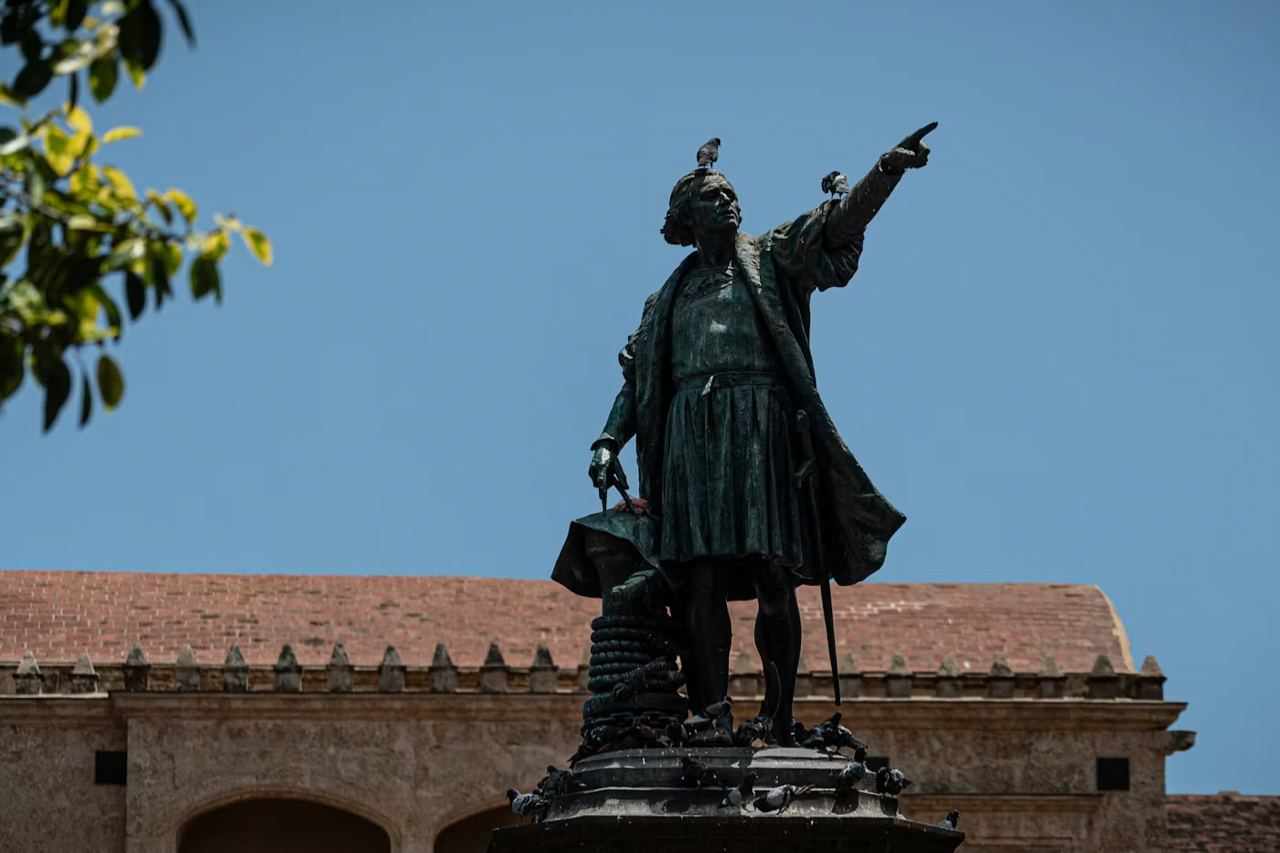
The expectation for oppressed people to celebrate their oppressors reflects a complex power dynamic where domineering groups project their own narratives, values and holidays onto marginalized communities. This is an ongoing attempt to force participation in celebrations or expressions of gratitude to legitimize their authority and maintain the status quo.
Columbus Day is an official federal holiday, commemorating Christopher Columbus’s arrival in the Americas on October 12, 1492. Today, Americans are expected to celebrate his legacy of colonization, murder and oppression of Indigenous peoples.
Take the day off as if he took a load off their shoulders. I’m just supposed to shrug my shoulders when asked to celebrate an oppressor. No, celebrating Columbus glorifies a Eurocentric view of history that whitewashes genocide, land dispossession, and systemic oppression.
Columbus and his crews subjected the Taíno and other Indigenous populations of the Caribbean to kidnapping, physical mutilation and enslavement. But I’m expected to treat this brutal history as water under the bridge, as if the passing of time lessens its ripple effects. Instead, expeditions introduced devastating European infectious diseases and brutal exploitation, which caused the Indigenous population of Hispaniola to plummet from hundreds of thousands to near extinction within decades.
Columbus’s arrival initiated the violent displacement of Indigenous populations and laid the groundwork for chattel slavery in the Americas. Columbus’s expeditions launched an era of violent colonization, enslavement, forced assimilation, and catastrophic depopulation among Indigenous peoples. His voyages tied the fate of African and Indigenous peoples together under European imperialism.
Another point of fact, the push for a national day honoring Columbus began in the late 19th and early 20th centuries to protect Italian Americans from severe discrimination and anti-Italian violence, such as the 1891 mass lynching in New Orleans. Following the murder of New Orleans police chief David Hennessy, 11 Italian immigrants and Italian Americans were brutally murdered by a mob after six defendants were acquitted and a mistrial was declared for three others.
Columbus Day was originally championed not just as a celebration of exploration, but as a direct civil rights initiative to help integrate and protect Italian Americans during a period of intense xenophobia. Also, to appease the growing Italian American voting bloc, President Benjamin Harrison declared a one-time nationwide celebration of Columbus in 1892, marking the 400th anniversary of his landing.
This gave Italian Americans, who were viewed as “un-American,” stereotyped as violent, inferior and prone to crime, as incapable of assimilating, a historical stake in the foundation of the Americas. At the time, Columbus was seen as a heroic figure, making him an effective “cultural bridge” for assimilation. Isn’t this all so ironic?
Still, courts and public officials often questioned whether Italians fit into the traditional white racial category of the time. Italian Americans were part of the country’s “racial odyssey” as they went from being viewed as “swarthy” and “not quite white” in the 19th century to being fully accepted as “white” Americans by the mid-20th century. “The legal equation of whiteness with fitness for citizenship shaped the process by which race was made in the United States,” David R. Roediger pointed out in Working Towards Whiteness: How America’s Immigrants Became White.
So, Columbus became a symbol of integration and a way to combat intense ethnic and religious discrimination. Isn’t that moronic?
Consequently, maintaining a national holiday dedicated to Columbus minimizes historical atrocities and honors a legacy of conquest rather than discovery. It also reveals deeply contrasting perspectives on American history, culture and national identity. The traditional historical narrative treats Columbus as an icon of exploration and a representation of global connections that ultimately led to the founding of modern nations in the Western Hemisphere.
However, the historical record of Columbus’s governorship of Hispaniola, now modern-day Haiti and the Dominican Republic, is heavily documented through contemporary accounts, including his own logs and the writings of eyewitnesses like Bartolomé de las Casas in his History of the Indies. The island’s population dropped from an estimated several million down to roughly 60,000 between 1494 and 1508 due to war, slavery and the grueling conditions of the gold mines.
It is estimated that 94% to 98% of the Indigenous Taíno population was decimated within a few decades of the Spaniards’ arrival. Today, it stands as one of the most drastic demographic disasters in recorded history.
In response to these conflicting viewpoints, there has been a significant shift in how Columbus Day, proclaimed a federal holiday in 1937 by President Franklin D. Roosevelt, is observed. An increasing number of U.S. states, cities and institutions now celebrate Indigenous Peoples’ Day instead. This alternative holiday is designed to honor the history, cultures and resilience of First Nations people, reframing the day to focus on the communities that existed long before the arrival of Europeans.
So, join me in a round of applause for them. Because we don’t celebrate oppressors.
- About the Author
- Latest Posts

Director of The Raceless Gospel Initiative, an associate editor, host of the Good Faith Media podcast, “The Raceless Gospel” and author of Take Me to the Water: The Raceless Gospel as Baptismal Pedagogy for a Desegregated Church.